
In this article
- What is online therapy?
- Is online therapy as effective as in-person?
- How private is online therapy in Ghana?
- Online vs in-person: full comparison
- Who should choose online therapy?
- Who should choose in-person therapy?
- Online therapy for specific conditions
- How to start online therapy in Ghana today
- Frequently asked questions
- References
What Is Online Therapy?
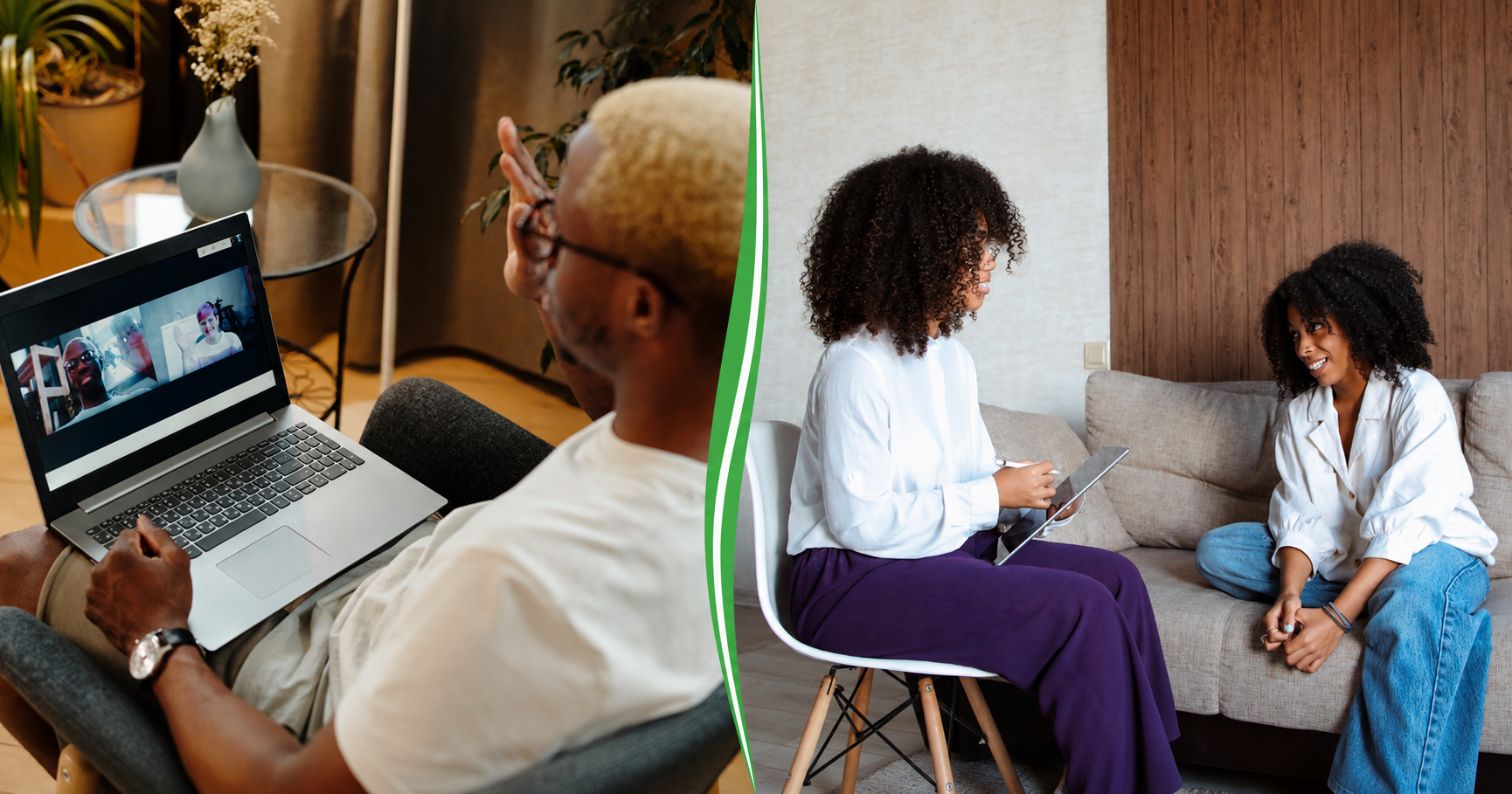
Online therapy — sometimes called teletherapy, e-therapy, or virtual counselling — is therapy that happens over the internet rather than in a physical office. You connect with a licensed therapist or counsellor via video call, and the session proceeds exactly as it would in person: you talk, they listen, ask questions, and help you work through what you're experiencing.
On Sariya Health, online sessions are conducted via Google Meet. You receive a private link when your booking is confirmed, click it at the scheduled time, and you're in — from your home, your car, your office, or anywhere in Ghana with an internet connection.
Online therapy is not a new concept. It has been practised and researched extensively since the early 2000s, and the body of evidence supporting its effectiveness has grown significantly — especially following the global shift toward digital healthcare during the COVID-19 pandemic.
Is Online Therapy as Effective as In-Person Therapy?
This is the first question most people ask — and the answer from research is a clear yes, for the majority of people and the majority of conditions.
A landmark review published in the World Psychiatry journal found that internet-delivered cognitive behavioural therapy (CBT) produced outcomes equivalent to face-to-face therapy for depression and anxiety disorders. Similar findings have been replicated across multiple studies for relationship counselling, grief, stress management, and general emotional support.
What matters most in therapy is not the room — it's the relationship between you and your therapist, the quality of their training, and your own willingness to engage honestly. All of these things transfer completely to a video call.
The research consensus: Online therapy is clinically equivalent to in-person therapy for depression, anxiety, stress, relationship issues, grief, and most common mental health presentations. The format changes — the effectiveness doesn't.
There are some exceptions — severe trauma processing, certain complex psychiatric conditions, and situations where a client genuinely cannot feel safe without physical presence. We'll cover those in the in-person section. But for the vast majority of people seeking therapy in Ghana, online is not the compromise option. For many, it is genuinely the better one.
How Private Is Online Therapy in Ghana?
This is arguably the most important question for Ghanaians specifically — and the answer matters more here than in most countries.
Mental health stigma in Ghana is real. Many people who would benefit from therapy avoid it because they fear being recognised — by a neighbour, a colleague, a church member — walking into or out of a mental health clinic or hospital. That fear is not irrational. It is a genuine social risk that keeps thousands of people from getting the support they need.
Online therapy eliminates that risk entirely. Nobody can see you attend a session. There is no waiting room. There is no building with a visible name on it. You join from wherever you feel comfortable — your bedroom, your car, an empty meeting room at work.
How your data is protected on Sariya Health
- Sessions are conducted via encrypted Google Meet video calls
- Your profile, session history, and areas of concern are stored with row-level security — only you and platform administrators can access them
- Your sensitive health information (diagnoses, areas of concern) is stored in a separately restricted database table
- We do not use advertising tools, analytics trackers, or third-party cookies — your data is never used for advertising or profiling
- Your conversation history with Sariya AI is stored only to provide continuity — it is not shared with third parties
For maximum privacy during sessions: Use headphones, find a quiet private space, and if you're at home, let anyone else in the space know you'll be on a call. A parked car is one of the most private options many people use.
Online vs In-Person Therapy: Full Comparison
Here's a complete side-by-side breakdown across every factor that matters when choosing between the two formats in Ghana:
| Factor | Online Therapy | In-Person Therapy |
|---|---|---|
| Effectiveness | Clinically equivalent for most conditions | Clinically equivalent for most conditions |
| Privacy & stigma | ✓ No one sees you attend. Maximum anonymity. | Risk of being seen entering a clinic or hospital |
| Access across Ghana | ✓ Available anywhere with internet — no travel required | Limited to your city or area. Very limited outside Accra. |
| Cost | ✓ Lower — no transport, no parking, flexible pricing | Higher — session fee + transport + time off work |
| Convenience | ✓ Join from home, car, or office. No commute. | Travel, waiting rooms, fixed location |
| Technology required | Smartphone or laptop + stable internet connection | Transport only |
| Physical presence | No — video only | ✓ Yes — some clients need this to feel safe |
| Scheduling flexibility | ✓ Broader availability, evening and weekend slots easier to find | Often limited to clinic hours |
| Best for | Anxiety, depression, relationships, career, grief, coaching | Severe trauma, complex psychiatric conditions, clients who need physical presence |
| Not recommended for | Severe trauma processing requiring somatic work; psychosis | People outside major cities; those with mobility or transport challenges |
Who Should Choose Online Therapy?
Online therapy is the right choice for most people in Ghana seeking support for the first time. Specifically, it is the better option if:
You're worried about being seen
If stigma or the fear of being recognised is the main thing stopping you from starting therapy — online removes that barrier completely. This alone makes it the right choice for most Ghanaians.
You're outside Accra
Qualified therapists in Ghana are concentrated in Accra and a few other major cities. Online therapy makes professional support accessible regardless of where you are in the country.
Your schedule is demanding
Online sessions are easier to fit around work, family, and other commitments. No commute means a session during your lunch break or after the kids are asleep becomes genuinely possible.
You're dealing with anxiety or depression
For the two most common mental health conditions in Ghana, online therapy is as effective as in-person. There's no clinical reason to choose in-person for anxiety or depression specifically.
You want relationship or couples counselling
Online relationship counselling is particularly effective because both partners can join from the same space — or separately if preferred. It often reduces the tension of sharing a physical waiting room.
Budget is a consideration
Online therapy eliminates transport costs and tends to offer more flexible pricing. On Sariya Health, sessions start from GHS 30 through the one-time session programme.
Who Should Choose In-Person Therapy?
Online therapy is not right for everyone. There are genuine situations where in-person is the more appropriate choice — and it's important to be honest about them.
You are processing severe or complex trauma
Trauma therapy — particularly approaches like EMDR (Eye Movement Desensitisation and Reprocessing) or somatic therapy that involve body-based work — is often more effective in person. The physical presence of a therapist can be an important source of co-regulation and safety when working with deeply distressing material.
You have a severe psychiatric condition
Conditions like active psychosis, severe bipolar disorder, or serious self-harm require close monitoring and may need in-person clinical care, potentially in combination with psychiatric medication management. A psychiatrist rather than a therapist is likely the right starting point.
You simply cannot feel safe without physical presence
For some people, the physical presence of another human being in the room is essential to feeling safe enough to open up. This is a valid personal need — not a failure. If you've tried online therapy and consistently find it difficult to connect, in-person may be genuinely better for you.
You don't have a stable internet connection
A session interrupted repeatedly by poor connectivity is frustrating and counterproductive. If your internet is unreliable, in-person therapy offers a more stable experience — or find a location with better connectivity before booking online.
Online Therapy for Specific Conditions in Ghana
Not sure whether online therapy is effective for what you're specifically dealing with? Here's the evidence by condition:
Anxiety
Online therapy — particularly CBT (Cognitive Behavioural Therapy) delivered via video — is one of the most well-researched and effective treatments for anxiety disorders. Multiple randomised controlled trials show equivalent outcomes to in-person CBT. Sariya Health's Mental Wellness category includes therapists experienced in anxiety treatment.
Depression
Online therapy for depression is equally well-supported by research. Studies published in journals including JMIR Mental Health consistently show that internet-delivered therapy reduces depressive symptoms as effectively as face-to-face sessions. For mild to moderate depression — which describes the majority of people seeking support — online is a fully appropriate treatment format.
Relationship and couples counselling
Online relationship counselling is particularly well-suited to the Ghanaian context. Couples can attend from the same location or separately — removing the logistical challenge of both partners commuting to a single clinic. Research on online couples therapy shows strong outcomes for communication improvement and conflict resolution. Visit our Relationship Harmony page to see available professionals and packages.
Addiction and substance abuse
Online therapy for addiction support — including motivational interviewing, CBT for substance use, and relapse prevention planning — has strong research support for mild to moderate presentations. For severe dependency requiring medical detox or inpatient rehabilitation, in-person clinical care is necessary. Sariya Health's Addiction Management and Drug & Alcohol Abuse categories offer online support for the recovery journey.
Career stress and burnout
Career coaching, burnout recovery, and professional development sessions are highly effective online — arguably more so, since clients can join directly from their work environment and discuss real-time challenges. See our Career Growth category.
How to Start Online Therapy in Ghana Today
Starting online therapy on Sariya Health takes under five minutes. Here's exactly what happens:
Create a free account
Sign up at sariyahealth.com. A short onboarding asks for your name, location, and areas of concern — this helps match you with the right professionals.
Choose your support category
Browse Mental Wellness, Relationship Harmony, Career Growth, Addiction Management, and more. Each category has its own specialists.
Pick a package or apply for a one-time session
Select a session package, or apply for the sliding-scale one-time session programme starting from GHS 30 if standard pricing is out of reach.
Choose a therapist, date, and time
Read therapist bios, pick someone who feels right, and select from their available slots. Sessions are 45 minutes.
Pay securely
Complete payment by card or mobile money. Booking confirmed instantly. Your Google Meet link arrives by email.
Attend from anywhere in Ghana
Click the link at the scheduled time. No downloads, no setup. Just show up.
Ready to start online therapy in Ghana?
Browse licensed therapists and counsellors on Sariya Health. Private, flexible, and available across Ghana — from GHS 30.
Browse therapistsFrequently Asked Questions
Is online therapy as effective as in-person therapy in Ghana?
Yes. Research consistently shows online therapy is clinically equivalent to in-person therapy for the most common conditions — depression, anxiety, stress, and relationship difficulties. The format changes; the effectiveness doesn't.
How private is online therapy?
Very. On Sariya Health, sessions are conducted via encrypted Google Meet calls. No one in your physical environment knows you're attending therapy. Your data is never used for advertising or shared with third parties.
What does an online therapist do?
Exactly the same as an in-person therapist — listen, ask questions, identify patterns, and help you develop practical strategies. The only difference is the medium: video call instead of a physical office.
How do I know if I need therapy?
If persistent sadness, anxiety, or stress has been affecting your relationships, work, or daily life for more than two weeks — that's a signal. You don't need to be in crisis to benefit from therapy.
Can I get affordable online therapy in Ghana?
Yes. Sariya Health's one-time session programme offers sliding-scale pricing from GHS 30. Session packages also significantly reduce the per-session cost.
What conditions is online therapy best for?
Online therapy is highly effective for anxiety, depression, stress, relationship difficulties, career challenges, grief, addiction support, and lifestyle coaching. In-person may be preferable for severe trauma or complex psychiatric conditions.
References
This article draws on the following authoritative sources on online therapy effectiveness, mental health in Ghana, and digital healthcare.
World Health Organization — Mental Health
WHO overview of global mental health, access gaps, and the role of digital tools in expanding care.
American Psychological Association — Telehealth & Online Therapy
APA overview of the research on effectiveness of therapy delivered via technology.
JMIR Mental Health — Effectiveness of Internet-Delivered Therapy
Peer-reviewed journal publishing research on digital mental health interventions including online therapy outcomes.
Mental Health Authority Ghana
The statutory body regulating mental health services and practitioners in Ghana.
Ghana Health Service — Mental Health Programme
Ghana's national health authority, mental health data, and programme information.
NIMH — Psychotherapies
Overview of evidence-based therapy types and their delivery formats.
The Lancet Psychiatry — Digital Mental Health
Peer-reviewed research on digital and internet-delivered mental health interventions and their clinical outcomes.